Stainless Steel Industry Article
Expert Insights on Stainless Steel Products & Applications
Stainless Steel in Indian Railways: Grades, Standards, and the Opportunity Ahead
Indian Railways is in the middle of a generational modernisation drive, and stainless steel is at the centre of it. From Vande Bharat coach shells to bio-toilet assemblies and station infrastructure, the material’s role is expanding faster than most procurement teams realise.
Salem Stainless Steel Suppliers Pvt. Ltd.
The shift that changed everything
For decades, Indian Railways ran on carbon steel. It was cheap, familiar, and abundant. But it rusted, it corroded, and it demanded constant maintenance across tens of thousands of coaches exposed to monsoon humidity, coastal salt air, and industrial grime. The shift to stainless steel was not driven by aesthetics or ambition alone — it was driven by the mathematics of total lifecycle cost.
The turning point came with the LHB (Linke-Hofmann-Busch) coach programme. When Rail Coach Factory Kapurthala became the first Indian factory to switch entirely to stainless steel LHB shells, it demonstrated something the industry had long suspected: a stainless coach body, properly fabricated, could deliver a corrosion-free service life of 35 years or more. That number redefined the economics of Indian Railways procurement.
Today, over 75% of all non-multiple unit express trains run with LHB coaches, with 48,000 coaches added in recent years. That is a massive installed base of stainless steel rolling stock — and the programme shows no signs of slowing down.
Where stainless steel is used — and why each application matters
The railways application for stainless steel is far broader than coach bodies alone. Understanding the full picture matters for anyone supplying into this ecosystem.
Coach shells and structural frames: The frame of a Vande Bharat coach is made entirely of stainless steel, with a chassis 23 metres long. The structural choice is deliberate: stainless steel provides the combination of high tensile strength, weldability, and corrosion resistance needed for a design life of 35 years on a high-cycle, high-vibration application.
Bio-toilet assemblies: Indian Railways has installed over 2,45,400 bio-toilets across 68,800 rail coaches under the Swachh Rail, Swachh Bharat campaign. Every single bio-toilet assembly — the tank, the internal fixtures, the outlet piping — is fabricated in stainless steel, specifically chosen for its resistance to the chemically aggressive environment created by biological waste and cleaning chemicals.
Station infrastructure: Handrails, footbridges, platform canopies, facade cladding, and food court fitments across the Amrit Bharat Station Scheme are extensive users of stainless steel flat products and tubes. Over 1,300 stations have been identified for development under this scheme, representing a sustained pipeline of structural and architectural stainless demand.
Freight containers: Jindal Stainless fabricated a 20-foot stainless steel container for salt transport for Indian Railways, using SS 304 for the container body, with the prototype successfully completing loading and unloading trials in February 2026. Each stainless container can carry an extra 1.5 to 2 tonnes of payload per trip compared to conventional alternatives — a compelling economics argument for fleet-scale adoption.
Bridge reinforcement and infrastructure: India’s new Pamban Bridge — the country’s first vertical-lift railway sea bridge, inaugurated in April 2025 — was built with stainless steel reinforcement and anti-corrosion coatings, designed for a 100-year service life. In aggressive marine environments, stainless rebar is increasingly the specification of choice over conventional coated alternatives.
The grades that power the railways
Not all stainless steel is interchangeable. Indian Railways applications span a range of requirements — structural integrity, corrosion resistance, formability, and weight — and different grades are selected for each. Here is how the grade map looks in practice.
| Grade | Application | Why this grade |
|---|---|---|
| SS 304 | Coach interiors, kitchen equipment, freight containers, station fitments | Workhorse grade. Excellent corrosion resistance, good formability, widely available. The default for interior applications and non-structural elements. |
| SS 316L | Bio-toilet assemblies, coastal bridge components, marine environments | Molybdenum addition delivers superior resistance to chloride-induced pitting. Mandatory for applications exposed to waste, saltwater, or aggressive cleaning agents. |
| 201LN | VandeMetro external panels and car bodies | Jindal Stainless supplies 201LN for VandeMetro trains, reducing panel thickness from 3 mm to 2 mm vs conventional ferritic grades, resulting in lighter and more energy-efficient coaches. |
| Ferritic grades | Older coach body panels, underframe components | Lower cost than austenitic grades, adequate for less demanding applications. Being progressively replaced by 201LN and austenitic alternatives in new builds. |
| Duplex grades | Bridge structural elements, high-load freight applications | Approximately twice the yield strength of standard austenitic grades, with excellent stress corrosion cracking resistance. Specified where structural loads are highest. |
The Vande Bharat effect
If one programme has concentrated attention on stainless steel in Indian Railways over the past five years, it is Vande Bharat. The success of stainless steel in metro coaches has influenced Indian Railways to shift from LHB coaches to modern Vande Bharat coaches, with these newer stainless steel grades providing the smoothness and durability needed for better performance.
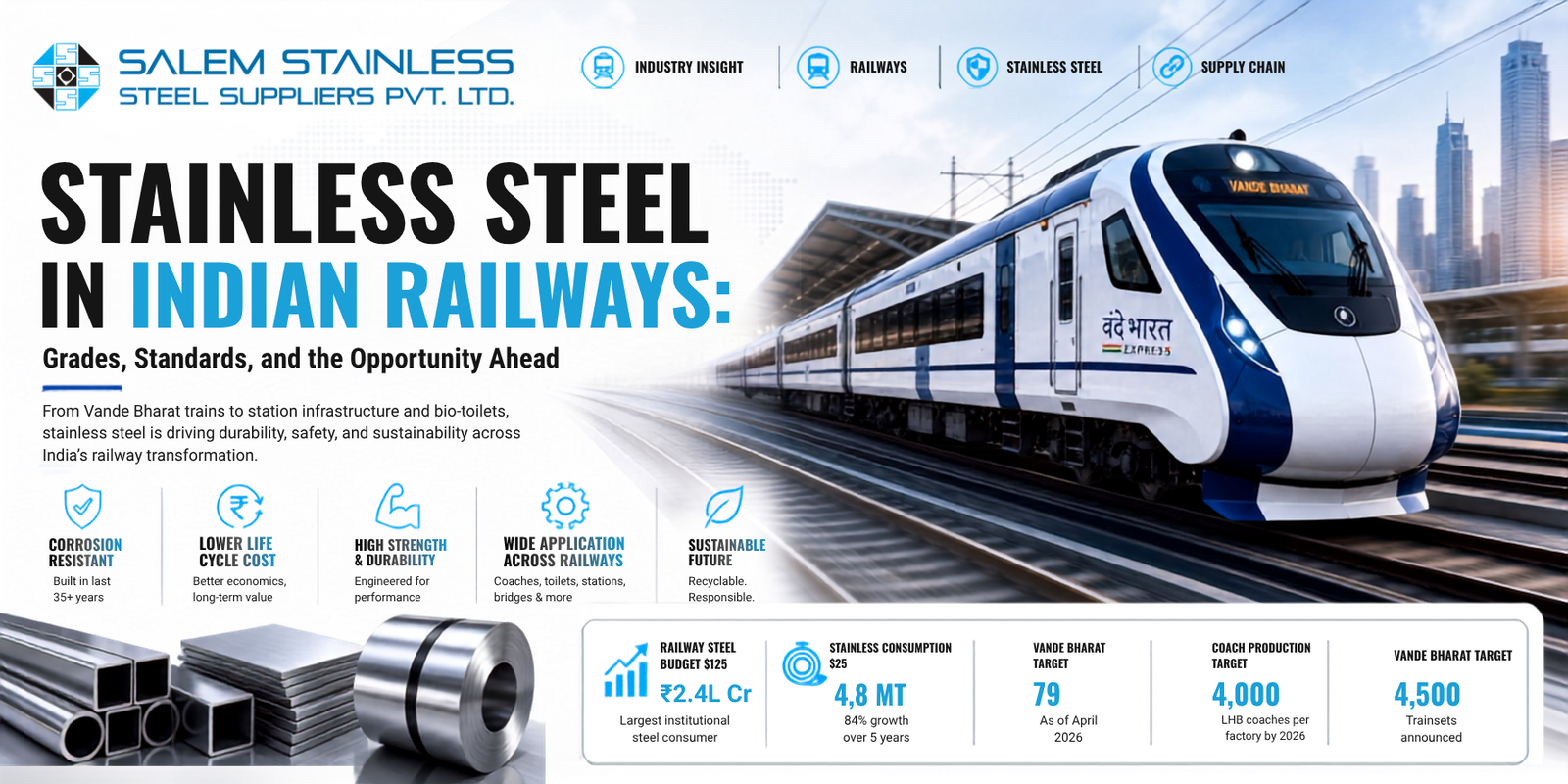
The Government has announced a target to have 4,500 Vande Bharat trains by 2047, with Vande Bharat Sleeper commercial services having begun in January 2026. Each 16-coach Vande Bharat rake is fabricated entirely in stainless steel. At current production rates and the announced targets, the volume of stainless flat products committed to this programme alone is enormous.
Mission 4000 sets a target of 4,000 LHB coaches per factory per annum by 2026, with RCF Kapurthala having been the first factory to switch completely to stainless steel LHB shells. The coach production targets are not aspirational projections — they are capacity commitments backed by factory investment and government budget allocations.
The speed ceiling — and where it changes the grade conversation
There is an important nuance worth understanding. Stainless steel is optimal for train speeds up to 160 kmph due to its durability and structural efficiency. Beyond this speed, aluminium is preferred as it reduces weight and improves system efficiency.
India’s semi-high-speed ambitions — the proposed 200 to 250 kmph corridors — will eventually require a different material calculus. Aluminium car bodies are already being piloted at Raebareli Coach Factory for this next generation. But this does not reduce the stainless steel opportunity in the near term. The vast bulk of India’s coach replacement programme — tens of thousands of LHB coaches and hundreds of Vande Bharat rakes — will be stainless. The aluminium conversation is a decade away at scale. The stainless opportunity is today.
What this means for procurement and supply teams
For OEM fabricators, component manufacturers, and Tier-2 suppliers in the railway ecosystem, the stainless steel specification landscape has become more demanding in several ways. First, grade selection matters more than it ever did — deploying SS 304 in a bio-toilet application or a coastal bridge component is not just a technical mistake, it is a warranty liability. Second, surface finish and dimensional tolerances in railway applications are tightening as ICF and RDSO standards evolve. Third, traceability — mill test certificates, heat numbers, and BIS-compliant documentation — is increasingly non-negotiable for institutional buyers in the railways space.
The opportunity ahead
India currently produces around 7,000 to 8,000 coaches annually, including metro coaches, and this number is likely to increase to 10,000 to 12,000 over the next five years, creating significant opportunities for stainless steel manufacturers. That production ramp, combined with the station redevelopment pipeline, the freight container initiative, and the ongoing bio-toilet refitment programme, represents one of the most sustained and predictable demand pipelines for stainless flat products in any Indian industry segment.
Indian Railways is also the country’s largest institutional consumer of steel. Stainless steel consumption in India reached 4.8 million tonnes in FY 2025, representing an 84% increase over the past 5 years, with a significant portion driven by greater stainless steel usage inside railway coaches, metro cars, wagons, and station architecture. The direction of travel is clear.
For suppliers, fabricators, and procurement teams, the question is not whether Indian Railways will continue to be a major stainless steel consumer. It will. The question is whether your supply chain is positioned to meet the grade, documentation, and reliability requirements of this market — because the standards are getting tighter, not looser, as the modernisation programme matures.
Salem Stainless Steel Suppliers has been an authorised distributor and channel partner for SAIL (Salem Steel Plant) and Jindal Stainless Limited since 1984, with branches in Chennai, Coimbatore, Cochin, Hyderabad, Delhi, and Mumbai. For grade-specific sourcing, mill test certificate documentation, or supply planning for railway and infrastructure applications, reach us at praful@ssssgroup.com or visit ssssgroup.com.
Tags: Indian Railways · Vande Bharat · SS 304 · SS 316L · 201LN · LHB Coaches · SAIL · Jindal Stainless
Praful R Director, Salem Stainless Steel Suppliers Pvt. Ltd.
praful@ssssgroup.com | ssssgroup.com

0 Comments